À effleurer, se rompre
Text by Morad Montazami, director of Zamân Books & Curating
After the skin, time stops.
Without it, everything collapses.
Nothing stands upright anymore,
Nothing clings to it.
After the skin, there is no one left.
Neither me nor you, only a mass of flesh remains.
After the skin, who will make the difference?
After the skin, one must accept defeat.
These lapidary words taken from a poem by the artist Golnaz Payani resonate in the void, that of a perforated body, in the manner of a voiceless cry¹. They seem to draw their poetic value (their power of address) from a troubled and inexpressible feeling: are they spoken from inside or outside the body? A body speaking to itself or speaking to its other? Is it disgust or astonishment that prevails in the face of such exposure, even dissection? So many questions arise, faithfully echoing the fearful doubt visible on the faces of the students in Rembrandt’s painting The Anatomy Lesson of Dr. Tulp (1632). A painting like no other in the history of Western art for thinking the relations between the visible and the invisible, beauty and ugliness, but also between seeing and knowing; tested against the human body as an obscene boundary, a limit between inside and outside. Nevertheless, the fragmentary words of this exergue-poem signify a major turning point in Golnaz Payani’s trajectory, which she herself situates in Après la peau, the title of her previous exhibition at the Chapelle Jeanne d’Arc in Thouars. She, who over the past ten years has become known through gestures of great meticulousness, bordering on a kind of poetic autism or creative madness, drawing with drops of water, sculpting with wool threads, filming folds reshaped by the wind, has over the past two years moved from the space of the cocoon to that of the carcass.
She now finds herself at the end of a transition between the paradoxical gesture of unweaving (in which she has become a master to the point of making it a total art and her signature) and the astonishing gesture of flaying. Thread and its methodical removal still constitute her leitmotif, but now in order to produce the tactile and carnal metaphor of skin. A fairly natural shift: in biology, one speaks of “tissue” to designate a set of cells grouped together in clusters, the intermediate stage between the cell and the organ. One might mistakenly have thought to place Golnaz Payani within the hybrid field of “textile art” (so fashionable that it becomes infinitely outdated), which she had nevertheless already thwarted by sacrificing all her time and energy to the unweaving of patterns of all kinds, including those of Persian tradition (to undo, to unravel, in order to better reveal, in hollow, memory or absence). Now she has entered an epidermal phase in which the roles of sculptor, surgeon, and embalmer intermingle.
One could say that Golnaz Payani now makes of skin, or of the beyond-skin (as one speaks of the afterlife), a question of life or death… of forms, of their memory and of their action in reality (one could speak of the life and death of the cells of a work of art as of those of a body). It is therefore symptomatic that from a practice of unweaving and decadrage of painting, tapestry, and embroidery, all delimited spaces inherited from the system of Fine Arts, she has moved to the flaying of the body and its skin, torn by the obsession of probing its own entrails, spaces without limit or of absolute limit, that which separates us from ourselves by objectifying our own fragility. As a direct consequence, Golnaz Payani’s works spill beyond the frame, moving from the wall and the hanging rail to the surrounding environment, within a general economy of space that sees her more than ever assume her status as a sculptor; even though her practice is defined beyond the specificity of medium, first and foremost through affects and gestures. In 2022, during her participation in Asia Now in Paris, Golnaz Payani presented a large and imposing black flag, composed of thousands of unweaved threads, enthroned sovereignly in the middle of a public courtyard yet falling like a martyr-body². Something in this depressive anti-monument, a tribute to the Iranian insurrectionary movement “Woman, Life, Freedom”, already hinted at the artist’s new anatomical inclination.
The search for the limit between the body as skin or envelope and the body as flesh or entrails³ (as symbolized by the painting of Rembrandt’s anatomy lesson) represents the adjustment variable of a certain contemporary sculpture: the hyperrealist anthropomorphic works of Ron Mueck fascinate us by their ability to perfectly reproduce the skin-envelope while letting nothing of the flesh show through; those of Berlinde De Bruyckere paralyze us in a certain confusion, or transgression, between skin and flesh; finally, those of Anita Molinero, which do not represent bodies, seem to attack the envelope of materials such as plastic or resin in order to reveal their flesh. Within this genealogy of surgical sculptors, Golnaz Payani’s recent works take the risk of indecency and impurity, that of merging interior and exterior experience; bringing down immune systems and cosmetic effects, while playing on the erotic ambiguity proper to the powers of the formless: beyond binary and categorical distinctions (male/female, vertical/horizontal, dead/alive…), the skin becomes a site of intrusion for all physical desires and all metaphysical risks; “à effleurer, se rompre”, as the title of her present exhibition urges us.
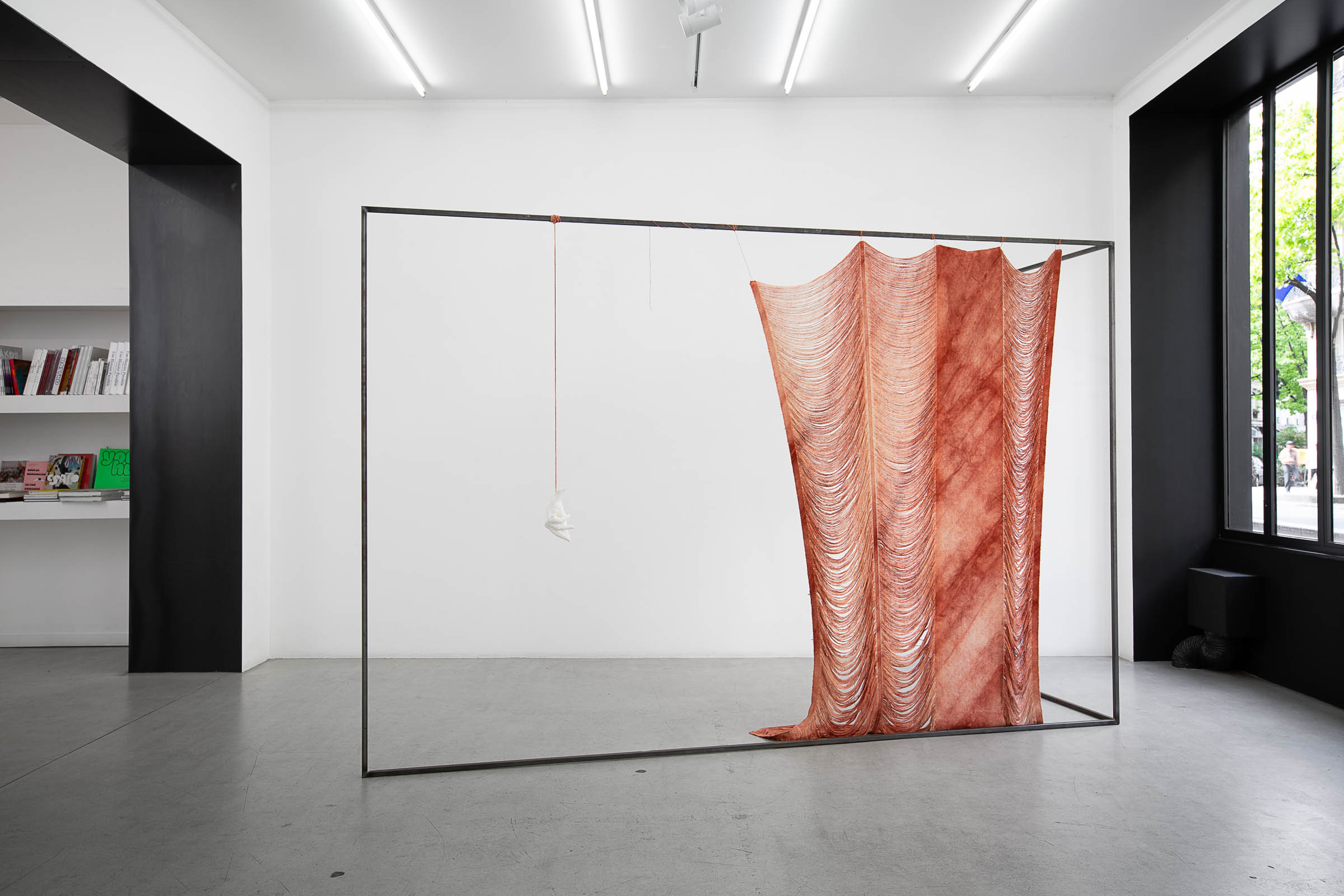
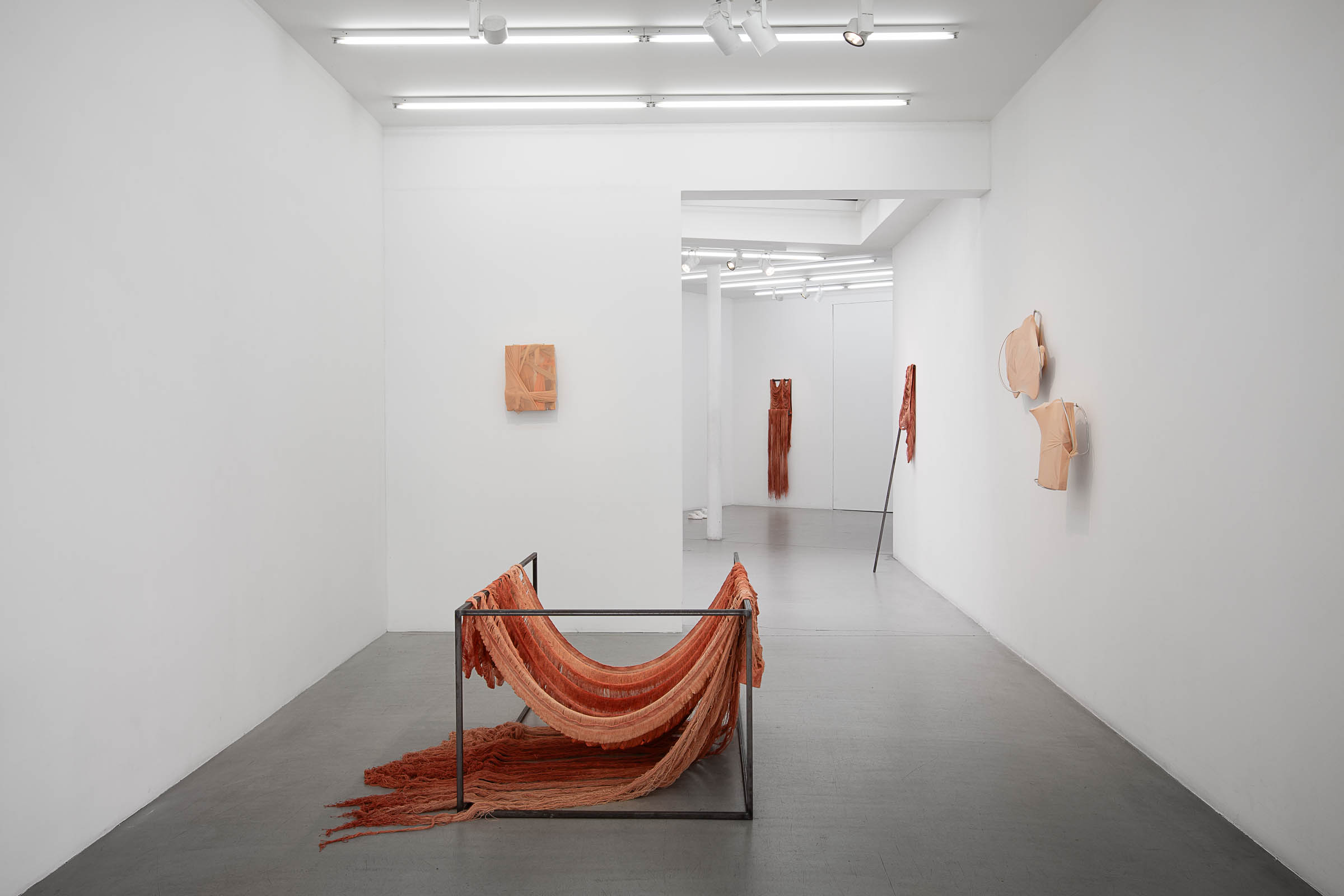
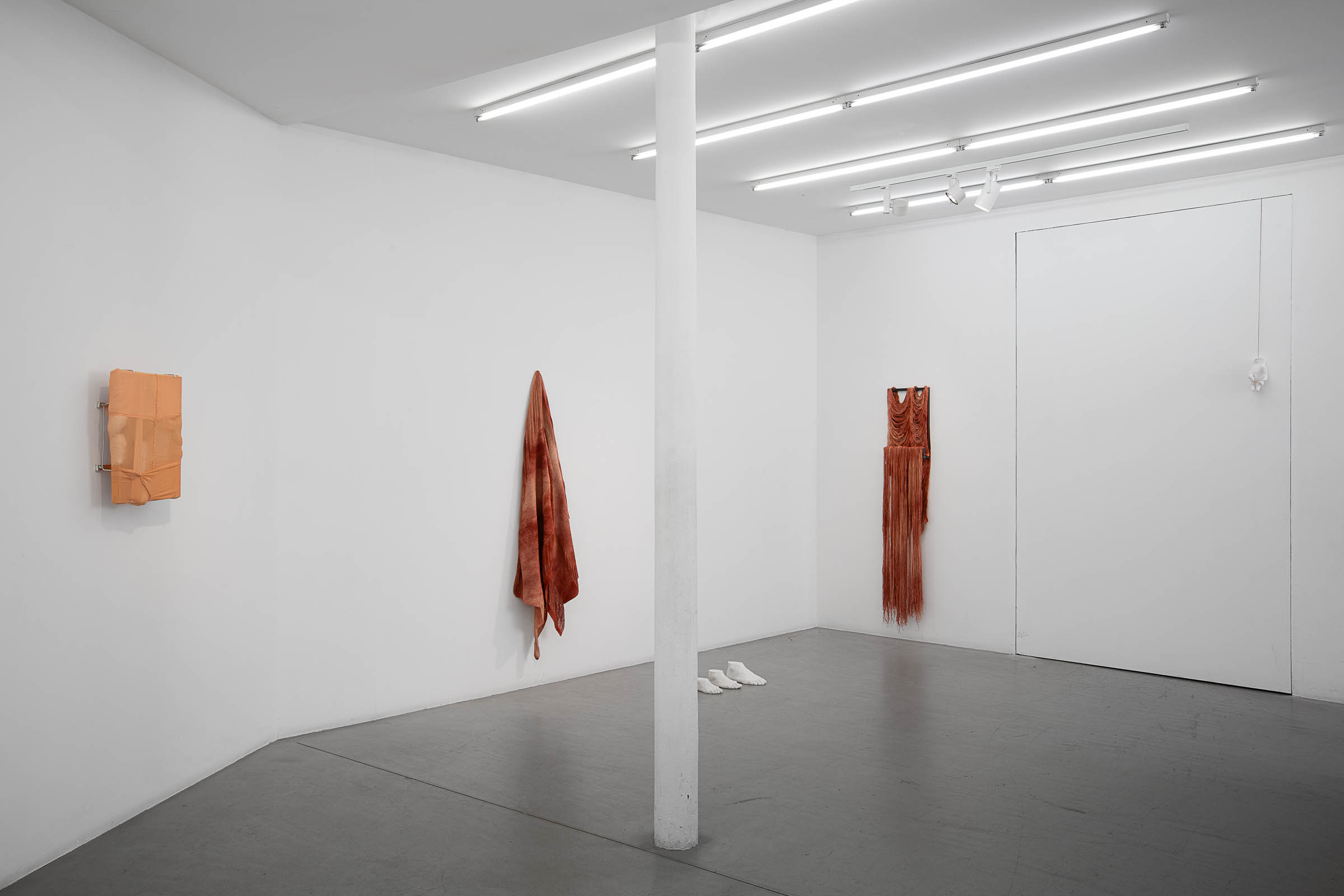
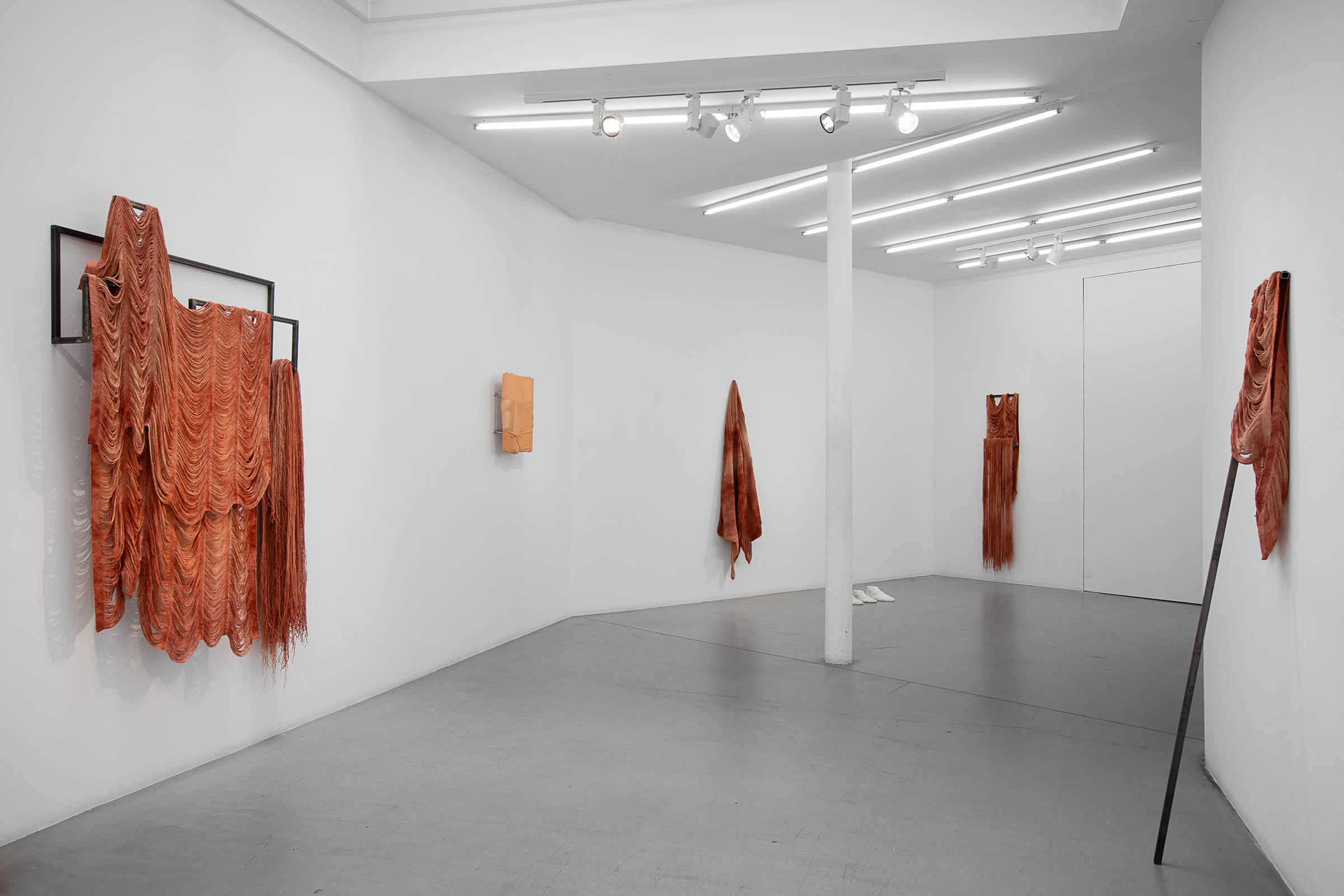
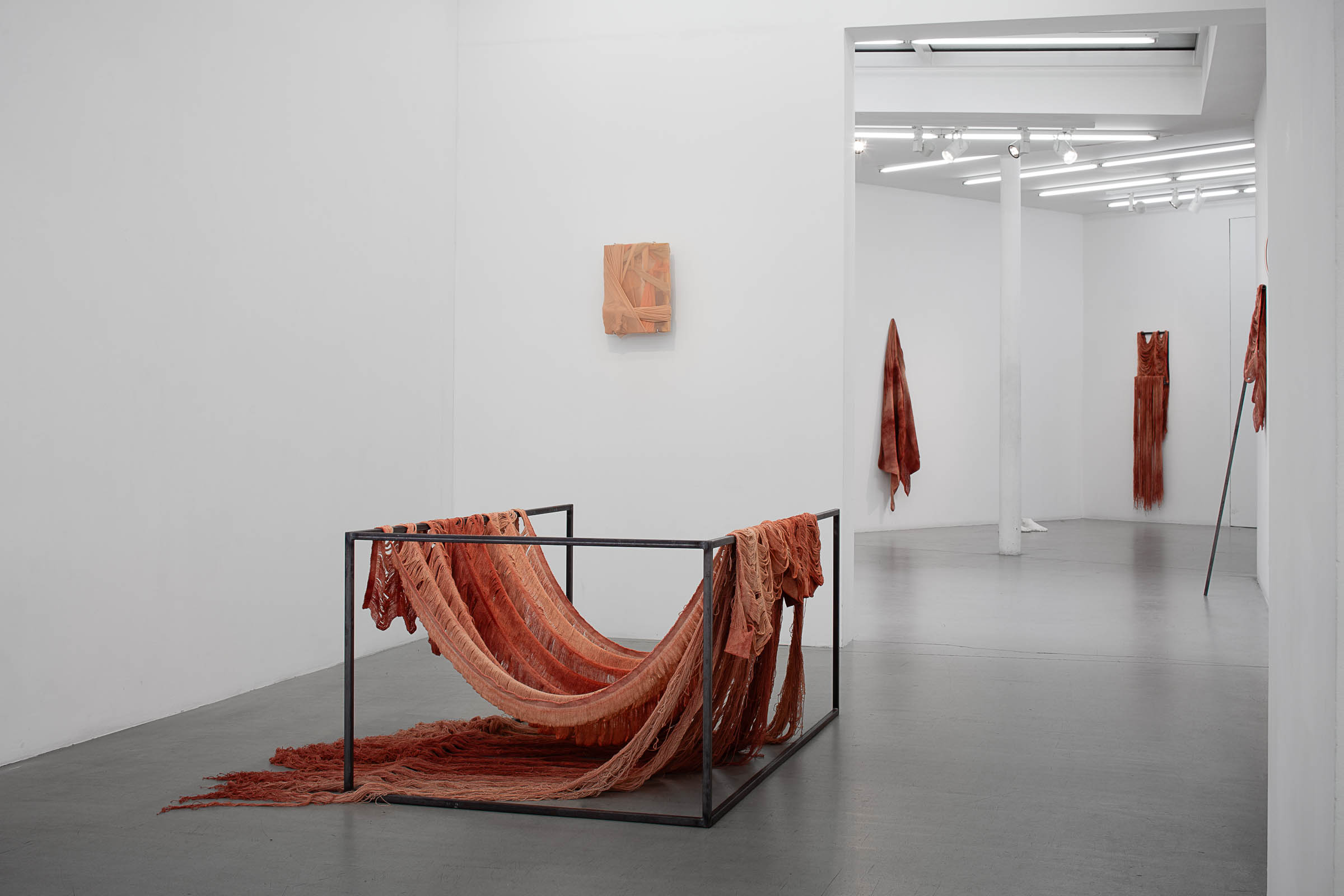
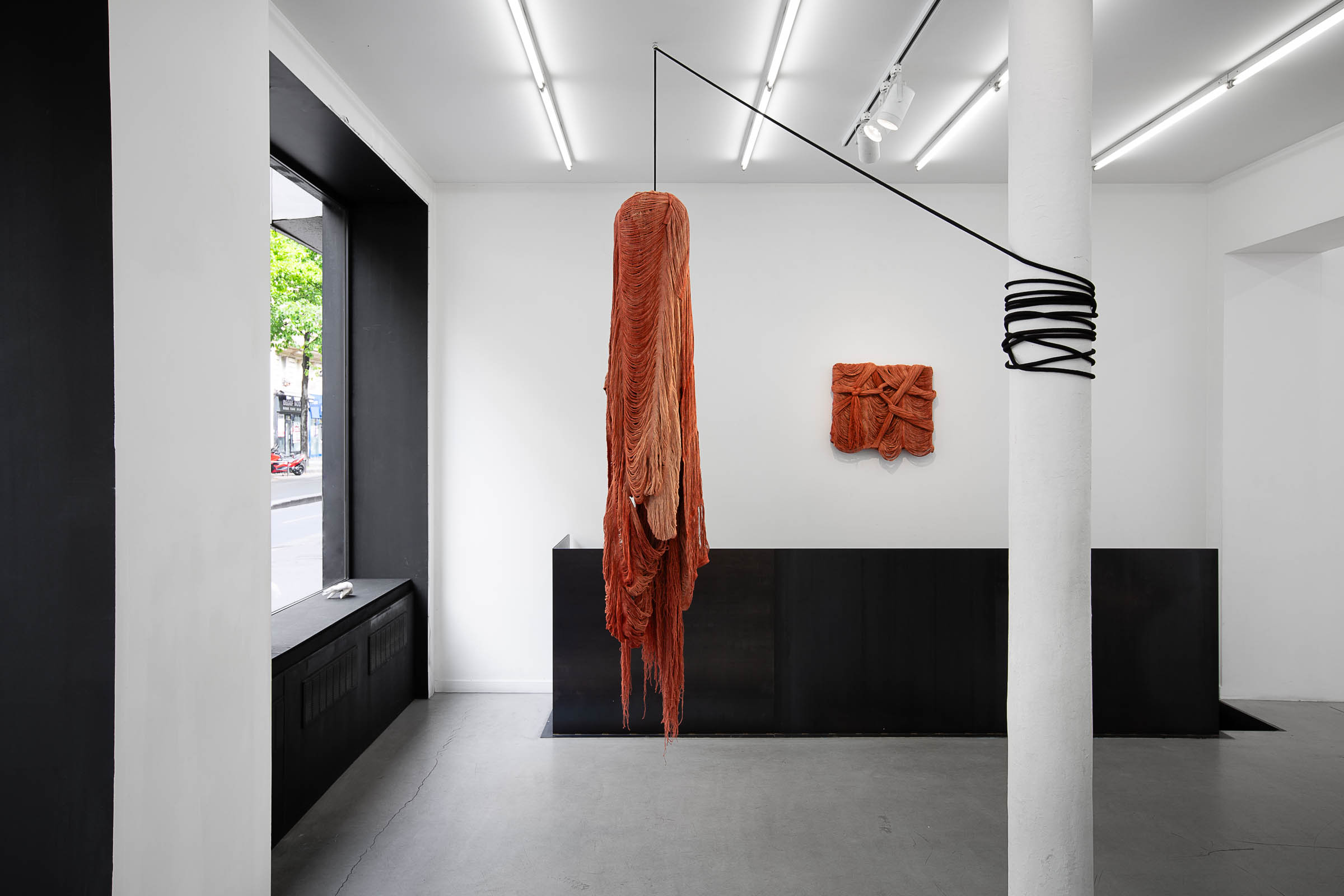
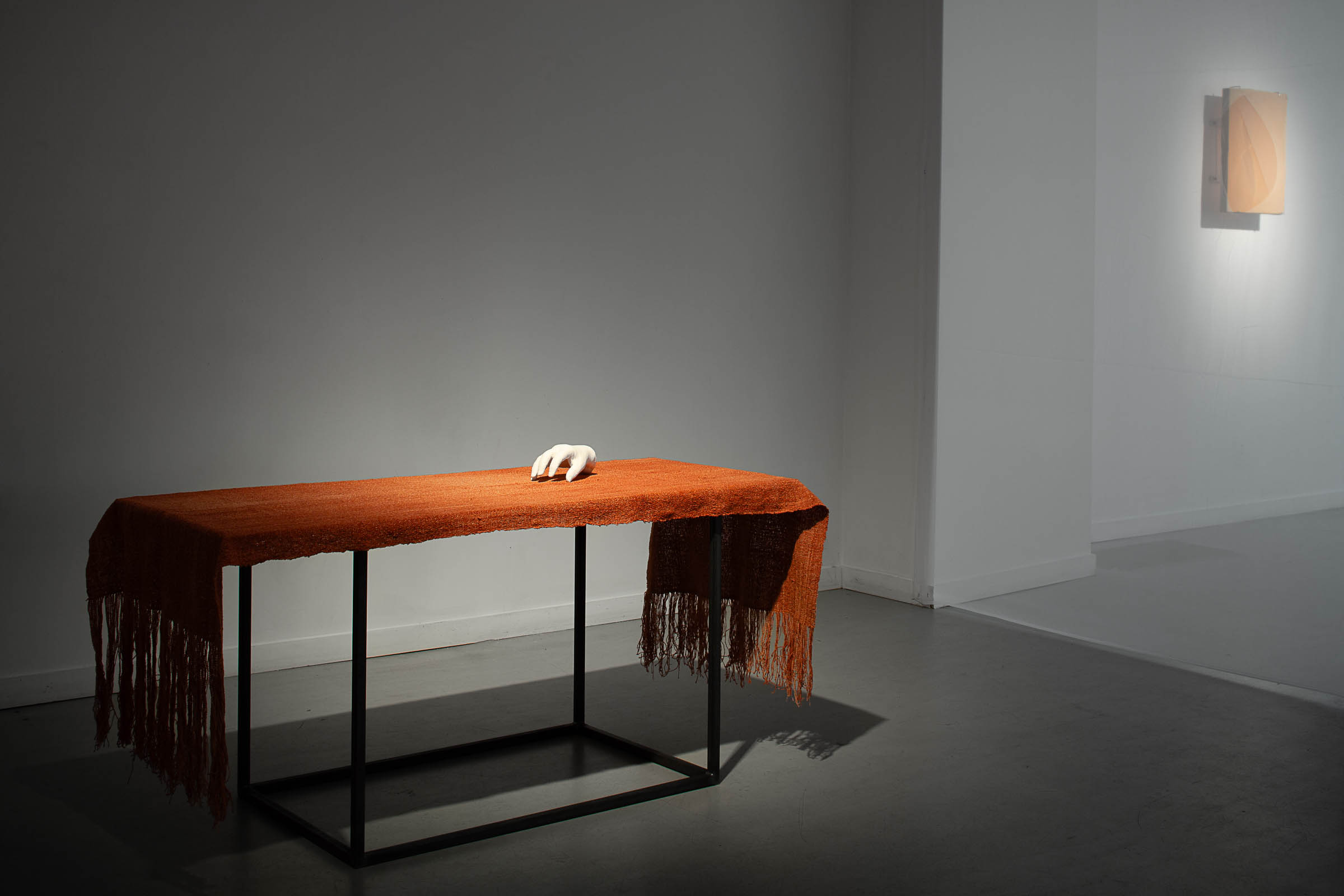
The installation devices (with their metal frames) through which Golnaz Payani allows us to see and touch her skin-sculptures extend the domain of visual arts and anatomical spectacle to that of a theatrical stage intended for ghost actors. In this case, the casts of feet and hands scattered among the lines of the metal structures and the flesh-fabrics (produced by the artist from elderly people encountered during her recent residency and exhibition in Thouars) reinforce this impression of a muted, faceless staging. Relics, ex-votos, body-fragments that alternately evoke desire and the failure to form a body. The metal structures operate both through mise en abyme (the flesh-fabric grafts itself onto them, doubling the erasure of the limit between inside and outside), through distancing (giving us the impression that the flesh-fabric could not be carried by human hands), and finally through reconfiguration (the metal structure gives a new form to the formless flesh-fabric). These three-dimensional structures, both displays of the unshowable and imaginary cages, persistently recall other images in which the second and third dimensions seem to intertwine, notably the many paintings of Francis Bacon in which flayed figures are inscribed within a double perspective: that of the pictorial field and that of the minimalist structures that enter into it like skeletons of architectural space.
The contact or the deposition (in the Christological sense) of the flesh-fabrics on the structures takes on different meanings: hanging laundry, laid tablecloth, drawn shroud, crucified body (the body is both omnipresent and fundamentally absent)… but they can also detach themselves to join the wall or be suspended from the ceiling. From then on, this skin torn from its refuge (bodily or theatrical), falling into the void and defying gravity, resurrects an archetypal image of Western culture and of 16th-century anatomical science: the flayed figure presented by Juan Valverde de Amusco in his illustrated treatise Historia de la composicion del cuerpo humano (published in Rome in 1556). This figure who tears off his own envelope, holding his skin in his right hand, a dissection knife in his left, thus exhibiting his flesh-body. It would find its source of inspiration in the figure of Saint Bartholomew (who presents himself in exactly the same way, his own skin in his left hand) painted by Michelangelo between 1534 and 1541 in the fresco of the Last Judgment in the Sistine Chapel (Rome). It is remarkable that Golnaz Payani manages to intervene in such an ancient iconography of the flayed figure through textile material alone, without any other artifice, except for her way of tinting the fabric with iron oxide. The latter, which gives Golnaz Payani’s draperies their troubling, living, and sanguine appearance, is intended as an organic artifice; whether it refers to the reddish water of sources such as the Rio Tinto, near Nerva in Spain, where the concentration of iron oxide is high, or to the presence of iron in the human body and blood⁴.
In a theoretical visual montage, deliberately anachronistic and untimely, Golnaz Payani brings together the flayed figure of Michelangelo and of Valverde de Amusco (16th century) with that of Ahou Daryaei; the Iranian student who undressed in November 2024 in the courtyard of Azad University in Tehran, as a protest against harassment by the morality police, and who became an icon of the “Woman, Life, Freedom” movement (two years after the death of Mahsa Amini)⁵. This feminist-revolutionary movement, which has demonstrated its strength and effectiveness, notably by obtaining the informal right for women to no longer wear the veil in public space, an immense victory regardless of its precariousness, comes, so to speak, to embrace and maximize decades of struggles by women in Iran for their freedom to dispose of their bodies and live in self-determination; against the patriarchal and religious yoke imposed since the 1979 revolution. Golnaz Payani, who lived in Iran throughout her schooling and university years until the age of 23, has concretely experienced these struggles, which can take public, political but also intimate and personal forms. Although collectively subjected to an authoritarian power whose DNA is in a sense the oppression of women, each individual experiences subjectively the act of covering one’s body and head with a specific fabric. Golnaz Payani, for her part, immerses herself again in this first life, before exile in France, recalling the experience as if this fabric became not a second skin, but the skin itself or even an extension of the body. Hence the question she continues to ask herself, symptomatically, to this day and which still resonates when looking at her recent works: “Have we gained something, like an additional skin, or have we lost something, the body?”
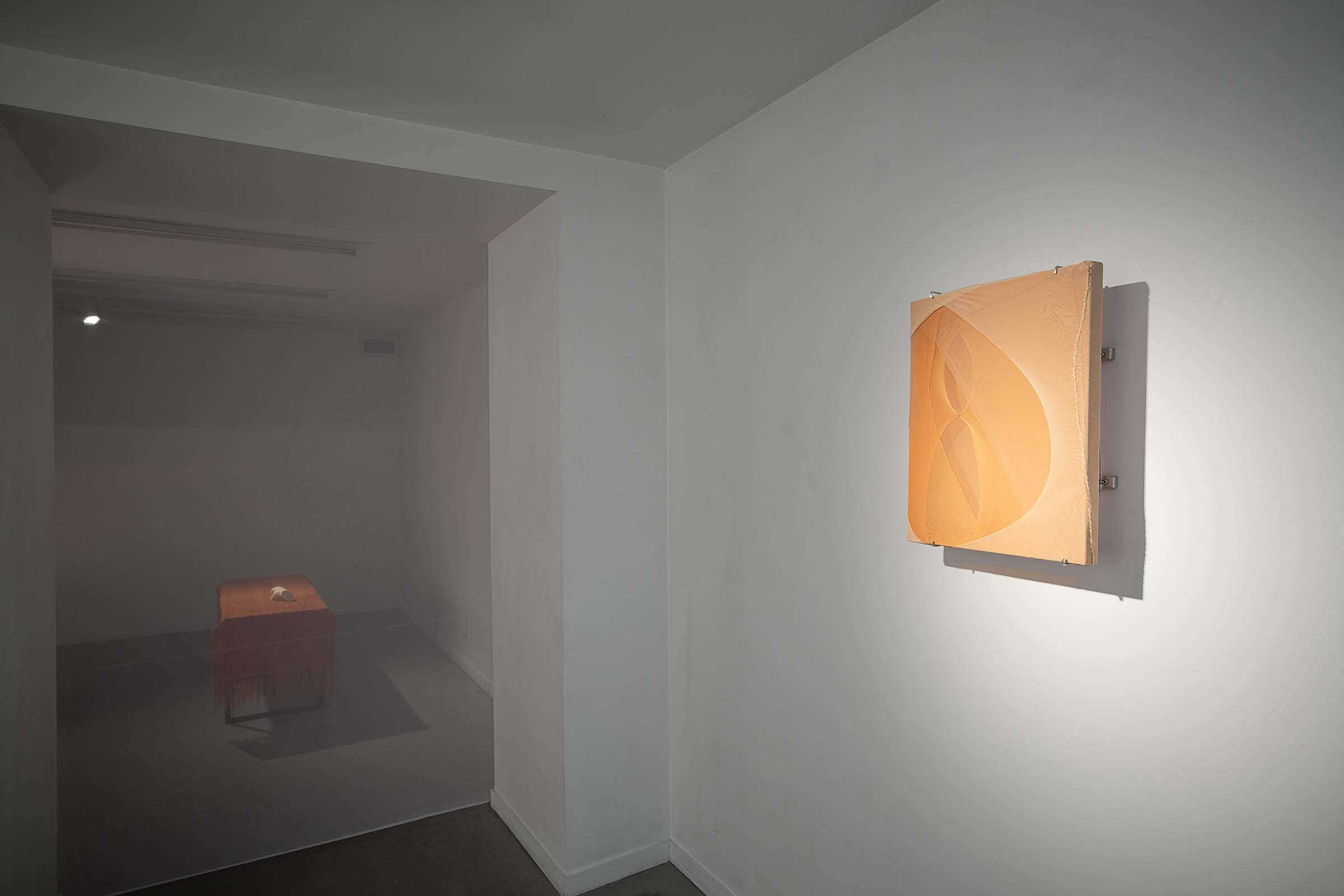
This is also the question that emerges from the skin-paintings also presented in this exhibition. These shift us from the ambiguities of theatrical space to the centrality and evidence of the wall; a shift seemingly thwarted by this other series by Golnaz Payani in which fabrics and nylon tights (a derivative or byproduct of petroleum) are superimposed and stretched like a spider’s web (which replaces the supposed canvas of painting). This gives form to a painting that is not exactly hung on the wall but slightly detached (thanks to a system of hooks at the back of the painting). The skin-paintings seem to play with our ability to see “through,” that is, our archaeological or “scanner-like” vision, through the layers of fabric or the fibers of each fabric… to play with our ability to create palimpsests of words and images in our minds, until they form only a weave without beginning or end. Golnaz Payani’s skin-paintings are at once extensions of the body and an ablation of the body. They revive the paradoxical memory of covering oneself excessively in order to better uncover oneself, of disappearing in order to better reappear. Ambiguous and ambivalent objects, these works cultivate the symbolism of secrecy, the trauma of the unsaid (of what has been covered), the ritual gesture of covering a body for burial, but also the exuberance and irony of infinite wrapping and of a container without content.
Although subjected to the purely coercive power of the veil by the Islamic Republic of Iran, each individual ultimately develops strategies of subversion and survival in the face of this relatively homogeneous but not flawless power. Naturally, the wearing of the Islamic veil has undergone inflections and subversions since 1979; it has shaped generations of temporarily silent activists who internalized the worst humiliations and constraints before one day taking to the streets and removing their veil, or cutting their hair, at the risk of their lives. Thus, it is not a simple naked body that Ahou Daryaei reveals in her transgressive gesture of unveiling, but rather the beyond-skin of a flayed body. Nor are they merely fragments of tapestry that Golnaz Payani patiently dismembers to reach the depths of vision through the fibers of flesh-fabric and flayed skin; but entire sections of familial, social, and anthropological memory that she assumes to reduce to ashes, forming membrane-banners of a body in struggle.
¹ Poem titled “After the Skin, There Is No One,” written on the occasion of a residency and the exhibition Après la peau in the city of Thouars, La Chapelle Jeanne d’Arc, Centre d’Art Contemporain d’Intérêt National, October 11, 2025 – January 4, 2026.
² “I believe as much in construction as in ruin: I undo in order to make, I unweave in order to generate form. This flag, neither fully raised nor truly fallen, announces the uprising. For me, it is like a message of hope. Today, with this flag, I salute the new world that will be freely built upon the wounds of the past, upon hearts still in tatters. Woman, Life, Freedom.” Extract from the text written by Golnaz Payani accompanying the installation Emporté par le vent, 2022.
³ “What is most profound in man is the skin.” Paul Valéry, excerpt from L’idée fixe, 1931.
⁴ Red blood cells are the blood cells most abundantly present in plasma. They contain hemoglobin, which is itself composed of iron. It is thanks to this element that blood can transport oxygen throughout the human body. This is also why blood is known to have a distinctly metallic taste.
⁵ “A student harassed by the morality police because of her ‘inappropriate’ hijab did not back down. She turned her body into a protest,” reacted journalist Masih Alinejad on her X account.