At the Risk of Painting
Text by Léa Bismuth
“Sensation is what is painted.”
Gilles Deleuze
Tatiana Gorgievski first pursued advanced studies in philosophy, becoming a specialist in phenomenology and in the aesthetic thought of Emmanuel Kant, before devoting herself to painting. Yet her work is in no way theoretical: it is above all the site of an intense bodily confrontation, an energetic territory where rational thought gives way to sensation.
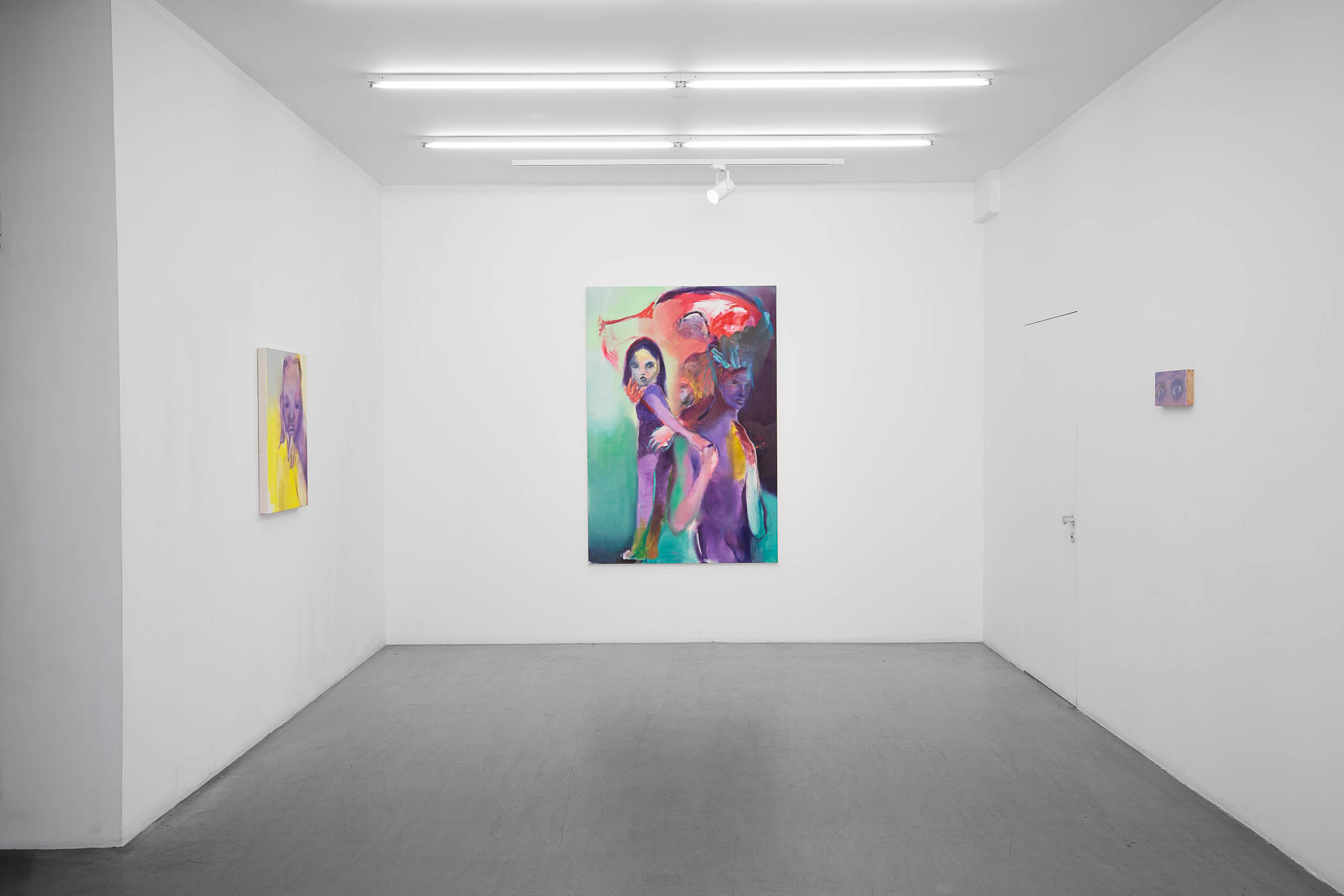
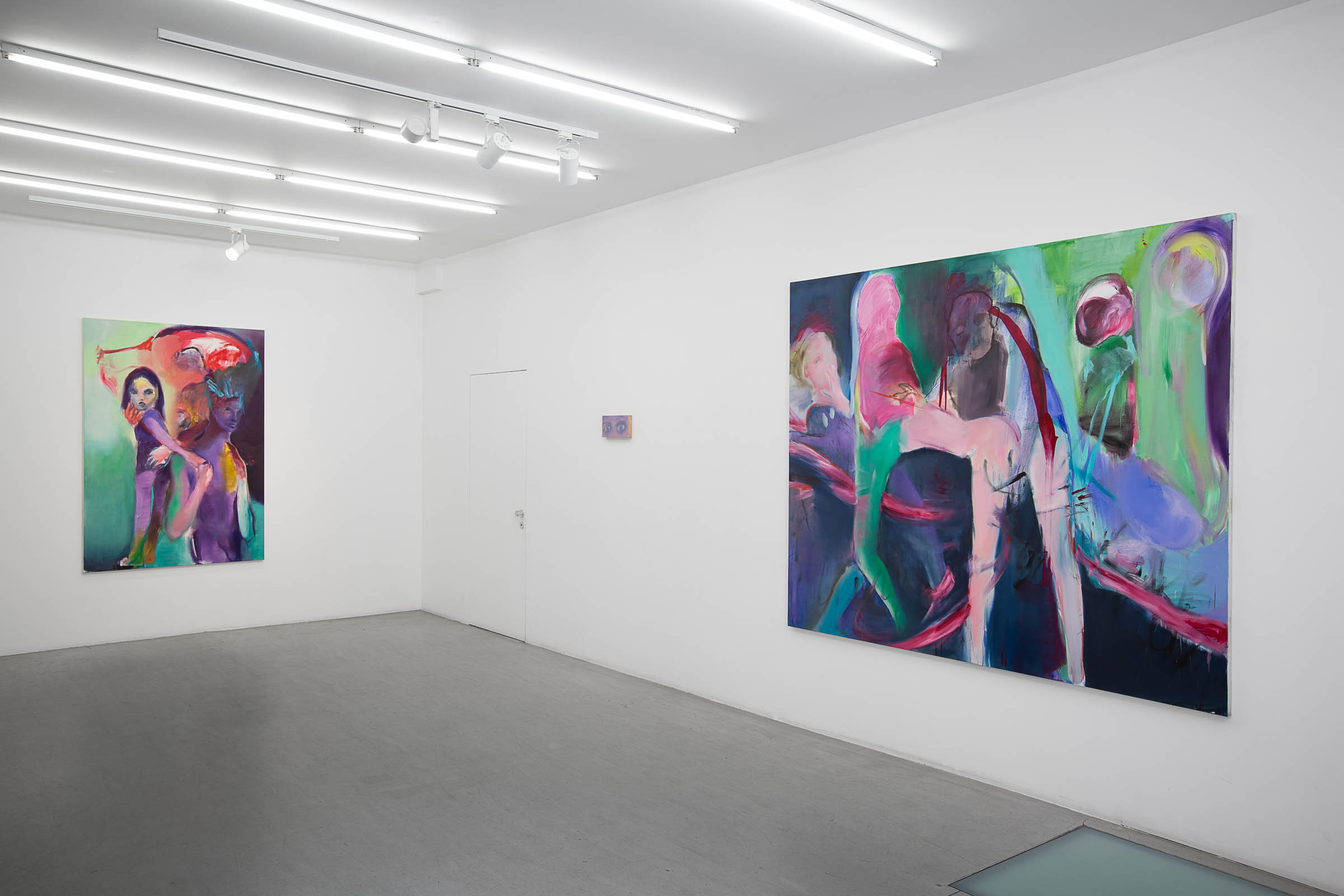
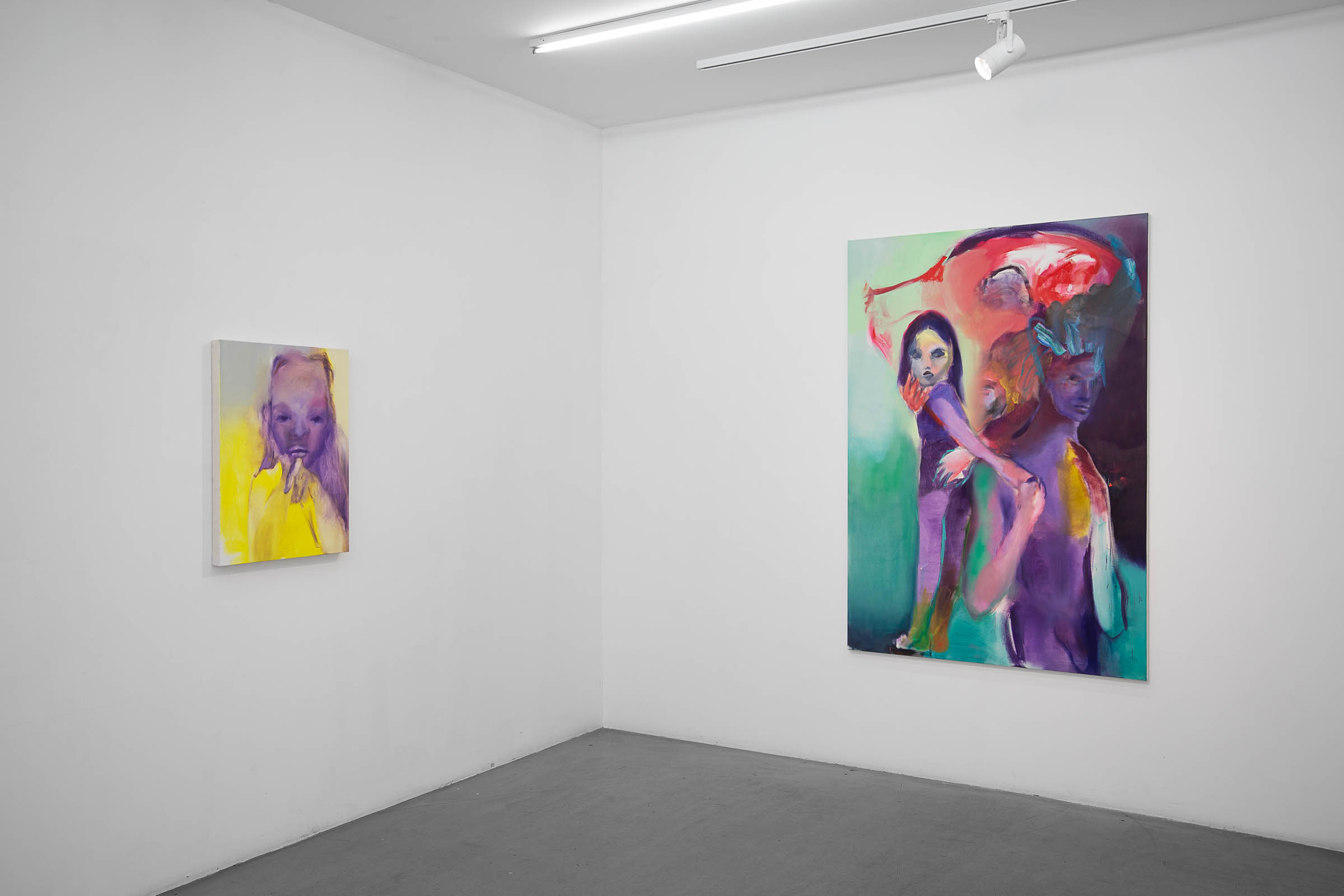
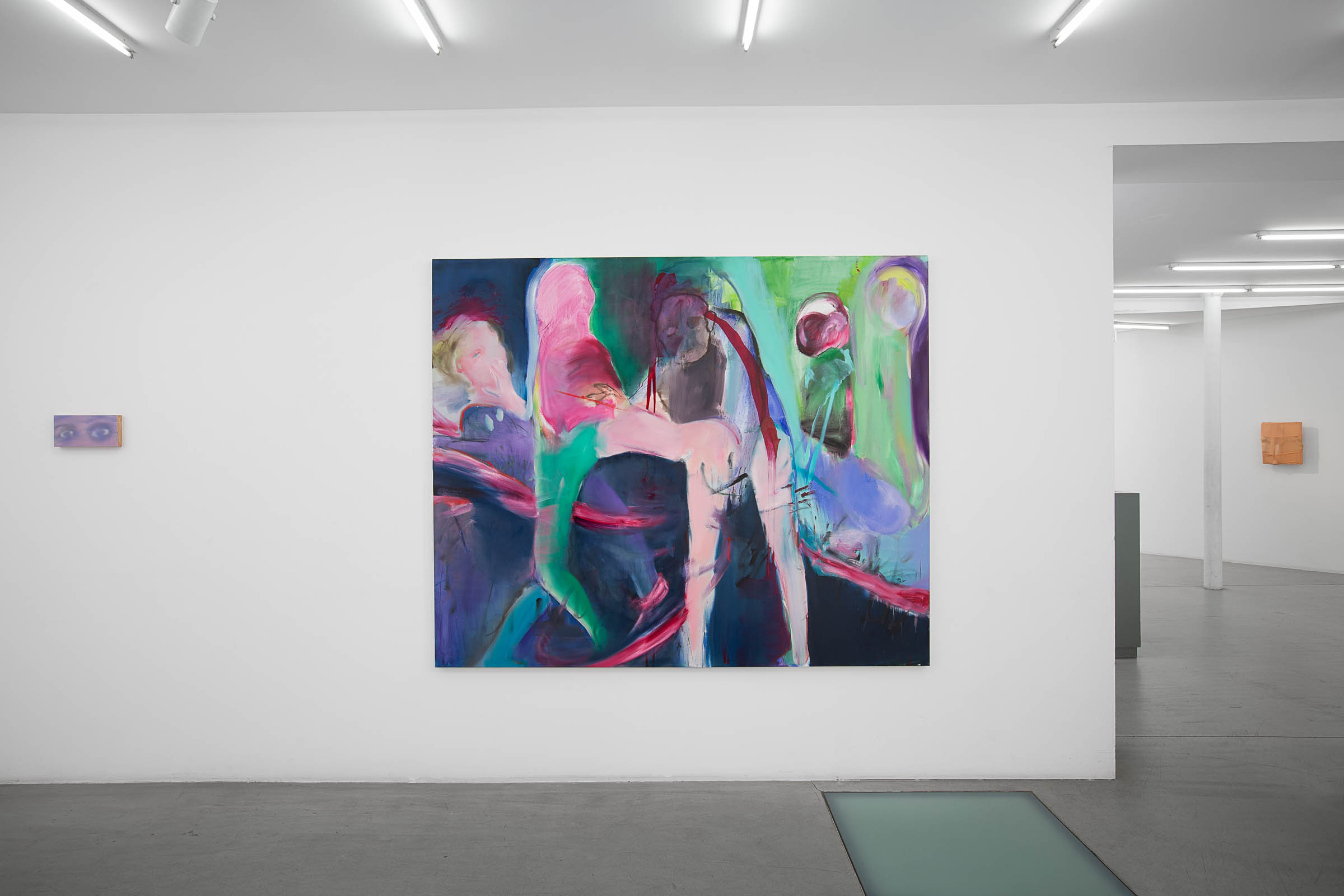
Executed in oil, the canvases present silhouettes that the artist brings forth without any preparatory work, in the immediacy of pleasure and the unconscious unpredictability of gesture. The large canvas titled The Skin I Don’t Have (2025) quite literally confronts the viewer with an arrangement of fragmented bodies melting into one another. Through a vivid and acidic palette—turquoise green, a near-fluorescent lilac violet, and a luminous flesh-pink—something seems to erupt. The eye experiences a space of pure sensation, and the retina shifts reflexively, tirelessly seeking a point of anchorage. If a form of violence strikes us head-on—a visceral, instinctual, undoubtedly sexual violence—there is here no direct meaning to decode, no representation to interpret. The technique, through successive erasures, layer upon layer, cultivates an art of blur and fluidity, granting access to the undecidable and the formless: the broad magenta streaks are blows, charged with defensive movements, yet the scene retains its share of secrecy. Painting thus cultivates a life of its own beyond accepted language, and the truth that emerges from it dispenses with words. It is here that I am reminded of Marlène Dumas, in the way she paints terror and outrage, always through slippages and with a kind of contained force; or again of Myriam Cahn, for her bodies strained and traversed by intensities, as if irradiated.
The title of this exhibition—Un corps qui tient—responds to the painting titled The Pact (2026), in which two bodies, though separated and back-to-back, nonetheless hold hands. Bodies ally and support one another, whereas in other scenes, marked by bruises, they disperse, strangle each other, merge, or ultimately lose themselves in a paradoxical, fusion-like embrace. One is led to ask: what exactly would a body that does not hold be? I believe this is what Gilles Deleuze, in relation to Francis Bacon and Antonin Artaud, sought to conceptualize with the “body without organs”¹: an insurrectional and intensive body, no longer responding to the dictates of an organism that is usually decision-making. The body without organs escapes in all directions while continuously unfolding new connections. Here, Tatiana Gorgievski confronts such bodies: she in fact dismantles organizing anatomy in order to find a new way of erecting and physically giving form to the anarchy of a body that would be nothing but desire and electricity. The face, likewise, when we believe we see it, is no longer a sum of features belonging to a traditional regime of legibility, but a vast space of release, a pure surface through which interiority and exteriority communicate. Deleuze, again, defines painting as “a block of sensations,” a field of vital forces emerging from a primordial, molecular, germinal chaos. To experience this, painters pass through a catastrophe, walking along a ridge line, at the risk of destruction, and the canvas retains the trace of such a detonation. These reflections resonate precisely with the words of Tatiana Gorgievski: “each brushstroke exposes one to irreversibility; at every moment it is a matter of risk. I move forward without knowing, only realizing afterwards what has taken place².”
Faced with these paintings, one becomes aware that form is placed under tension by raw forces. The space in which we stand effectively abolishes the usual distinction between abstraction and figuration, for only the act of painting matters: as a figural act. It is thus a matter of undoing resemblance, warding off identity, destroying narrative anecdote, in order finally to arrive at a dynamic and living becoming of painting.
Léa Bismuth holds a PhD in art theory (EHESS), and is an art critic, curator, and lecturer in aesthetics in higher education. She recently published L’art de passer à l’acte (PUF, 2024), and Étoiles communes (Actes Sud, 2026).
¹ These developments concerning Gilles Deleuze are inspired by two works: Francis Bacon – The Logic of Sensation (Éditions de la différence, 1981), and On Painting: Course March–June 1981 (Les Éditions de Minuit, 2023).
² Interview with the artist, April 2026.